Attribution
Credits
Every photograph, audio clip, and quoted source on this site belongs to someone. This page is where they are named.
Philosophy
The killdeer that prompted this exhibit was left alone. No photography or audio on this site was made at the nest. Every image is open-licensed from public archives - Wikimedia Commons, the National Park Service, iNaturalist contributors, and other federal public-domain materials. Audio recordings come from the National Park Service and from CC0 contributors on Freesound.
Each asset on the site appears with an inline caption that names its source. This page is the long-form ledger: every asset, every author, every license, every link back to the original. 39 items in all.
Photographs 30
-
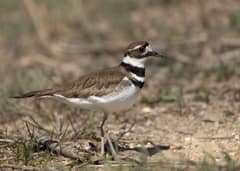
Charles Homler (FocusOnWildlife)
An adult killdeer in sharp profile on wet mud, the two black breast bands and bright orange eye-ring clearly visible against a softly blurred shoreline.
-
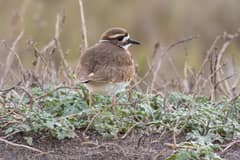
An adult killdeer standing on wet beach sand at Rodeo Beach, Marin County, California, head turned slightly to the right with the double black breast band and rufous rump visible.
-
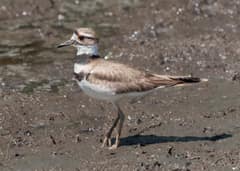
An adult killdeer in upright stance on sparse coastal vegetation at Sherwood Island State Park, Connecticut, with low afternoon light catching the white forehead band.
-

An alert adult killdeer photographed at South Cape May Meadows, New Jersey, body angled three-quarters to the camera, both breast bands and the bright eye-ring crisp against open ground.
-
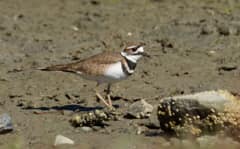
An adult killdeer standing at the edge of mudflats at Richardson Bay, California, slim grey-brown back and white underparts split by the two distinct black breast bands.
-
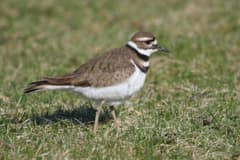
An adult killdeer foraging on damp grass at Cap Tourmente National Wildlife Area, Quebec, head lowered as it inspects the ground.
-

An adult killdeer in side profile on a gravelly shoreline at a Kansas lake, the bird centered against ripples of shallow water.
-
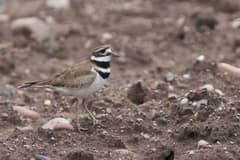
A sharply lit adult killdeer standing in short farm-edge grass at Longo Farm in Glastonbury, Connecticut, in late spring 2025.
-
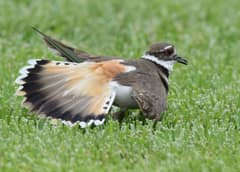
Andy Reago & Chrissy McClarren
An adult killdeer crouched low with its tail fanned and one wing dragged out and twisted, performing the broken-wing distraction display on bare ground.
-
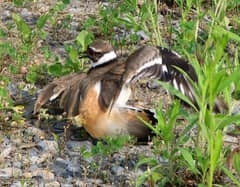
An adult killdeer with one wing splayed sideways over a rocky scrape, mid-distraction display, drawing attention away from a nearby nest.
-
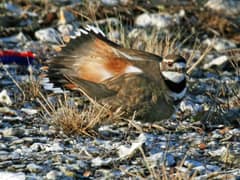
An adult killdeer in a low crouched display posture on sandy ground at Assateague Island, Virginia, with wings partly opened and tail spread.
-
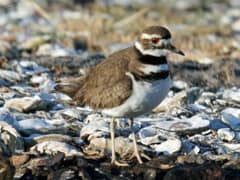
A second view of the same adult killdeer on bare sand, body lowered with one wing held out and the rufous rump exposed.
-
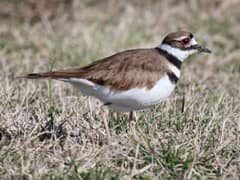
An adult killdeer standing upright on a sandy patch at Cape May, New Jersey, in a relaxed posture with both breast bands clearly visible.
-
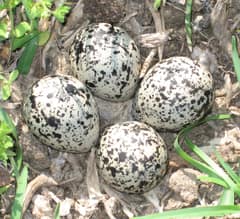
Four buff and dark-speckled killdeer eggs arranged in a shallow scrape lined with bits of dry grass, photographed from above.
-
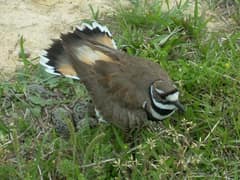
An adult killdeer standing close to four eggs in a gravel-lined scrape at a cemetery in Durham, North Carolina, the bird looking warily toward the camera.
-
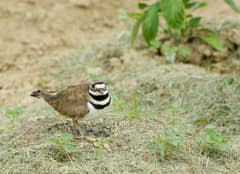
An adult killdeer settled low over four eggs in a stone-edged scrape in Louisville, Kentucky, body flattened in incubation posture.
-
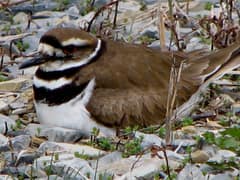
A female killdeer crouched in a shallow nest scrape on a Pennsylvania gravel patch, body pressed close to the eggs and head turned to one side.
-
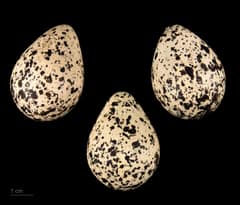
Three killdeer eggs laid out on a neutral grey studio backdrop, each speckled with dark brown blotches over a pale buff ground colour. From the Muséum de Toulouse zoology collection.
-
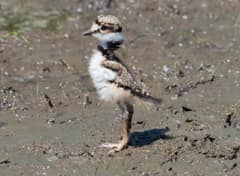
A downy killdeer chick on pale beach sand at Sherwood Island, Connecticut, single black neck band visible above oversized pink legs.
-
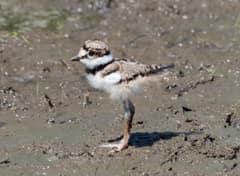
A second view of a downy killdeer chick at Sherwood Island, Connecticut, body angled away to show the rufous-tipped tail starting to come in.
-
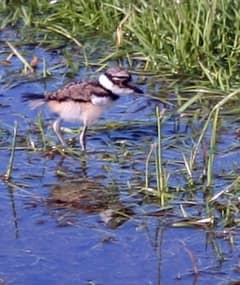
Leilah Thiel
A two-week-old killdeer chick foraging on damp soil at Flora Farm in Lynden, Washington, the body fluffy with the first dark band starting to define across the throat.
-
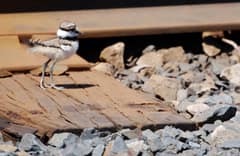
Two newly hatched downy killdeer chicks crouched on gravel in Portland, Oregon, their oversized pink legs and feet visible beneath a still-damp coat of down.
-
Neal Herbert (NPS, Yellowstone National Park)
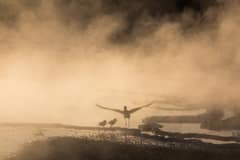
An adult killdeer beside two small downy chicks on the warm grey sinter surrounding Doublet Pool in Yellowstone National Park, low steam rising in the background.
-
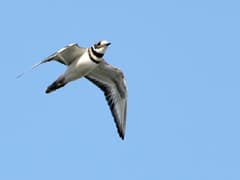
A killdeer in flight against an overcast sky in Algonquin, Illinois, long wings extended to show the bold white stripe and dark trailing edge.
-
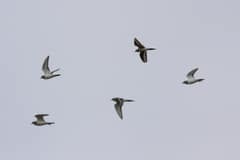
A pair of killdeer in flight, both birds banking together to reveal the white wing stripe and the warm rufous patch above the tail.
-
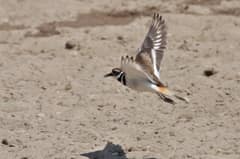
A killdeer captured at full wing-spread in flight over a field near Lisle, Illinois, both wings horizontal and the body in profile.
-
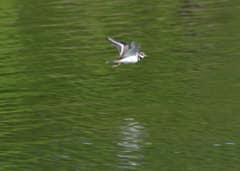
A killdeer flying low over the Humber River in Toronto, wings angled in a downstroke, water and shoreline blurred below.
-
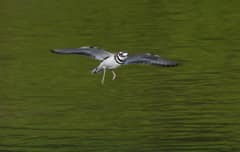
A killdeer caught mid-landing at James Gardens, Toronto, legs lowered and pink feet reaching forward as the wings cup air to brake.
-
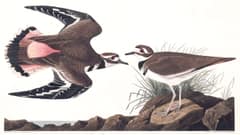
A hand-coloured aquatint engraving from Audubon's Birds of America showing two killdeer plovers: one with wings and fanned tail spread wide in a broken-wing display posture, and one standing upright on a rocky outcrop, both facing each other on a Florida shoreline.
-
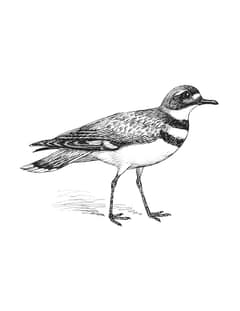
Black-and-white pen-and-ink line drawing of a single killdeer plover in profile, facing right. Two thick black bands cross the chest, a black band runs through the eye and across the forehead, and the long legs stand on a patch of sketched ground.


.jpg)
.jpg)
_at_Richardson_Bay.jpg)

_at_a_Kansas_Lake.jpg)

.jpg)

_RWD1.jpg)
_RWD2.jpg)


.jpg)
_-female_on_nest.jpg)

.jpg)
.jpg)


.jpg)
.jpg)
_in_flight_(3972179599).jpg)


.png)
Audio 6
-
A short clean 3.4-second recording of the two-note kill-deer call, isolated from background noise.
-
Peter Comley (NPS, Yellowstone National Park)
A 1 minute 40 second stereo field recording of multiple killdeer calling near Anemone Geyser in Yellowstone, layered with faint thermal hiss.
-
A 17-second recording of roughly ten killdeer calling together at Minnesota Valley National Wildlife Refuge, the calls overlapping in agitated chorus.
-
A long stereo soundscape from the Ohio River near Rosiclare in summer, with persistent killdeer calling, distant boat noise, and ambient wind.
-
A 58-second clean stereo recording of killdeer calling at Tommy Thompson Park in Toronto, with the two-note call repeated against a quiet background.
-
A 1 minute 19 second post-sunset field recording at Sherman Island, California, with killdeer calling alongside other shorebirds.
Video 2
-
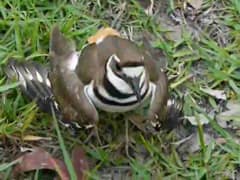
Randy Rodgers
A 28-second video clip of an adult killdeer dragging one wing across the ground and calling while moving away from its nest, performing the broken-wing distraction display.
-
A 29.5-second video clip of an adult killdeer foraging slowly across short grass at Longo Farm in Glastonbury, Connecticut, in late spring 2025.
Range maps 1
-
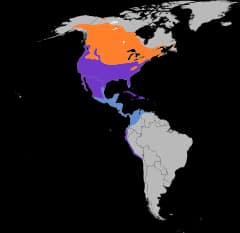
A range map of North and Central America showing killdeer breeding range across most of the continental United States and southern Canada, year-round range across the southern United States and Mexico, and non-breeding range extending into northern South America.

Statutes & references
- U.S. Fish & Wildlife Service - Migratory Bird Treaty Act of 1918
- 16 U.S.C. § 703 (Cornell LII) - Taking, killing, or possessing migratory birds unlawful
- 16 U.S.C. § 707 (Cornell LII) - Violations and penalties
- 50 CFR 10.13 (eCFR) - List of Migratory Birds
- Cornell Lab of Ornithology, All About Birds - Killdeer Life History
- de Framond, L. et al. (2022). Broken-wing display efficacy in killdeer , Proc. R. Soc. B, 289(1971): 20220058.
- South Carolina Department of Natural Resources - dnr.sc.gov